4. Home orientation
What way does your home face? If you have a North-South orientation, consider that your eastern windows will receive morning sun, and your western windows will bear the brunt of the afternoon sun. In Summer, rooms on the western side will require greater cooling. Knowing your homes’ orientation is vital when finalising a floorplan – consider where your main living spaces and bedrooms will be. This is also a part of “passive design,” which leads us to #5!
5. Incorporating passive energy efficiency design into your build
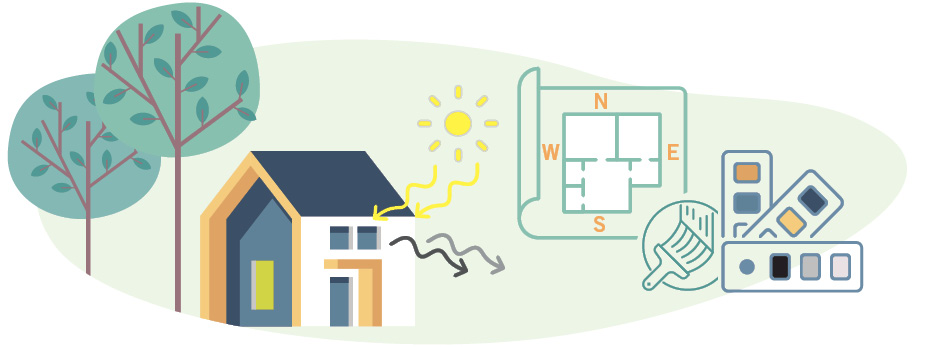
“Passive design” refers to design choices that work together with the local climate, to promote energy efficiency. Thinking about these elements at the build stage can strongly impact the energy required to heat and cool, and ultimately keep your home comfortable year-round.
- Consider your landscaping! It can play a big role in reducing the energy load on your heating and cooling. For example, deciduous trees planted on the southern and western boundary will provide natural shade for your home in the summer months, then drop its leaves to let the winter sun filter through.
- Did you know that insulating your walls can typically save around 15% on heating and cooling costs?3
- Double glazed Windows. They help reduce heat loss, or gain, by nearly 30% in comparison to single-glazed windows!4
- External roof and wall colours. In general, lighter coloured roofs reflect heat away, whilst dark coloured roofs will absorb heat, and then transfer it to rooms below. In cooler climates with long winters and shorter, more mild summers, a darker roof may be the more advantageous choice. The opposite is also true – that’s why it is so important to build to your homes’ surrounding environment.
Recent changes to the National Construction Code mean new home builds need to meet a minimum energy efficiency rating of 7-Stars, under the Nationwide House Energy Rating Scheme (NatHERS). Ask your builder about how your home meets this standard.
For an abundance of resources on energy efficiency at home, head to https://www.yourhome.gov.au/ – Australia’s guide to environmentally sustainable homes.
6. Placement of outdoor units
On average across Australia’s capital cities, block sizes for new homes have decreased by 13% from 2012-2021!2 With many homes being built to the boundary, it is important to consider the placement of the outdoor units of your heating and cooling systems. They need sufficient clear space around them to operate efficiently. Many will come with minimum clearances from hardscaping, like fences or other external walls. You should also consider the noise level, in relation to internal rooms. For example, you probably do not want to hear your air conditioner running outside your master bedroom all night!
7. Are you building a 2 storey home?
If you are going with a ducted heating and cooling solution, there will be cavities to allow duct work to travel between floors and deliver air-conditioned air to both levels. It can be helpful to know where these cavities are – for example running vertically through cupboards, walk-in-robes and linen closets. If you are planning to add an air conditioning system following the build, ensure provision has been made for this.
8. Power supply – single or three phase?
Do you know your power supply? Single phase is the standard method of distribution of electric power in most homes. For larger homes with multiple high powered appliances, three phase power is generally recommended and will deliver a much more consistent power supply than a single phase. It is important to choose your air conditioner based on your requirements, rather than the power supply readily available.
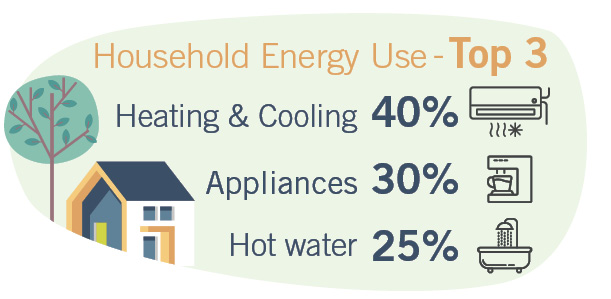
Source: 5 simple ways to save energy and money at home.
If you plan on running multiple high-powered appliances, it is important to understand what your home’s power supply can sustain. This is especially important if you plan to add to your home’s energy load at a later date, like an EV charging point, or pool or spa heaters and pumps for example.
9. Local regulations, incentives and rebates
The National Construction Code stipulates the minimum energy efficiency requirements for new homes. At State Government level, many offer incentives and rebates for homeowners to install more energy efficiency appliances. You may be eligible, and it is definitely worth asking your builder! This may also be something you wish to explore post hand-over, if you are unhappy with the builders range.
10. Understand your warranty and service requirements
It’s move in day! There’s a bit of chaos, a lot of excitement, and stuff EVERYWHERE. It’s more than likely your builder has left product and controller manuals for you in a kitchen drawer. Whilst (understandably) they may not be high on your priority list right now to review, make a note to get to know your warranty and the service requirements you need to meet, to maintain that warranty.
That’s a wrap! We hope these top 10 tips come in handy and wish you all the best on your home building journey!
Considering, or installing, a heating and cooling solution by Seeley International for your home? All our manuals can be found here.